
Joplin & Me

As many of you have probably heard me say before, I joined BHS in 1975 when I was just seven years old. Funny enough, that same year I picked up another hobby that would stick with me for life: the piano. And in my young mind, ragtime piano and barbershop harmony just naturally belonged together.
My mother still loves telling the story about my classical piano teacher calling her in one day to show her what I had done to my lesson book. Apparently, I had pasted barbershop tags over the endings of the classical pieces. I suppose even then I had arranging ideas!
By the time I was a teenager, I had fallen hard for ragtime piano and entered the Rosebud Ragtime Competition in St. Louis, run by the legendary Trebor Tichenor. I can still picture myself sitting nervously in those church pews listening to pianist after pianist tear through Scott Joplin rags at lightning speed while I waited for my turn. Impressive and intimidating.
The problem was - I had actually read Joplin’s instructions: “Do not play this piece fast. It is never right to play ragtime fast.”
Well, I figured if Scott Joplin wrote the thing, I probably ought to trust him.
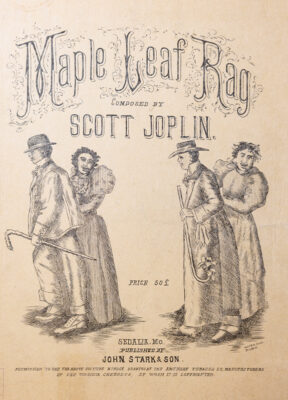
So, I played Maple Leaf Rag the way I believed Joplin intended it to be played.
Somehow, I ended up winning second place. I say “somehow” because first place went to Virginia Tichenor, Trebor’s daughter, who was, and still is, a truly marvelous pianist. But apparently, style counted for something that day, and that second-place finish earned me the chance to perform aboard the Goldenrod Showboat on the Mississippi River under the Gateway Arch, which, for a ragtime-loving teenager, felt about as magical as life could get.
That one little instruction from Joplin sent me down the road of learning more about the man himself, and what a story it turned out to be.
Scott Joplin was born in 1868 and left home at just fourteen years old, making a living playing in saloons and other rough-around-the-edges places across the South and Midwest. Then, in 1899, he published Maple Leaf Rag, a piece that truly changed American music. It sold an astonishing 75,000 copies in its first six months and gave Joplin something rare for a Black composer in that era: a steady royalty income.
And yet, despite all of that success, his later years were heartbreaking. Joplin died in 1917 at the Manhattan State Hospital and was buried in an unmarked grave. Before his death, he reportedly said people would appreciate his music 25 years after he was gone. Sadly, even he underestimated how long that would take.
It really wasn’t until the ragtime revival of the 1970s, thanks in large part to The Sting, that America rediscovered Scott Joplin. In 1976, he was finally awarded a special Pulitzer Prize for his contributions to American music. When you think about it, barbershop has actually done a remarkable job keeping its musical traditions alive compared to how long ragtime’s greatest genius had to wait for proper recognition.
Which brings me to why all of this matters right now.
As many of you saw in last week’s LiveWire, BHS will posthumously award Honorary Life Membership to Scott Joplin at this summer’s International Convention in St. Louis. And honestly, it feels fitting. Joplin clearly loved vocal harmony. In fact, his 1911 opera Treemonisha includes a quartet selection that sounds about as close to early barbershop as you could imagine.
So when we gather in St. Louis this summer, we won’t just be celebrating ragtime history or barbershop history. In many ways, we’ll be celebrating a shared piece of American musical history. And I have a feeling it’s going to be one very special moment.
