
A Guild of Quartets: 80 Years of Barbershop Harmony in Washington, DC
The year 2025 marked the 80th anniversary of the Washington, DC Chapter of the Barbershop Harmony Society—today known as the Singing Capital Chorus. To commemorate this milestone, longtime Society member and DC chapter singer Marc Wolfson undertook a deep dive into the chapter’s rich past. Drawing on stacks of preserved chapter newsletters, newspaper clippings, and historical documents carefully saved by earlier members, Wolfson set out to capture the chapter’s origin story and highlight the moments that shaped one of the Society’s most influential chapters. What emerged is a portrait of a chapter that helped define barbershop harmony in the Mid-Atlantic region and beyond.
The Founding Years
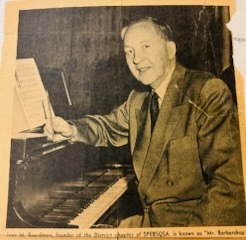
The Washington, DC Chapter was founded on October 29, 1945, when Jean Boardman gathered 23 men at All Souls Church. Boardman—an attorney by profession and a gifted music arranger by passion—was already well known within the Society. He arranged several early Society songs, including Asleep in the Deep, and after extensive research at the Library of Congress, Jean conceived of and directed the society’s Harmony Heritage program under which songs in the public domain were published and made available to society members.
From the start, Jean envisioned the chapter as a “guild of quartets.” Membership standards were rigorous: every prospective member was required to sing in a quartet before being admitted. This philosophy shaped the chapter’s musical culture and reputation for excellence.
The first person to sign the chapter’s charter application was Dr. Robert Howe Harmon, who became the chapter’s first chorus director. The second and third signers were founder Jean Boardman and John Cullen. Both Boardman and Cullen later served as the Society’s International Vice President, and Cullen went on to become International President in 1951.
Model Chapter and Regional Influence
The DC Chapter quickly gained recognition as one of the Society’s model chapters. Its members played a central role in expanding barbershop harmony throughout the region, helping to found chapters in Alexandria, VA; Charles Town, WV; Prince George’s County, MD; Annapolis, MD; College Park, MD; and Montgomery County, MD. Those chapters, in turn, sponsored others across Virginia and Maryland, including Richmond, Arlington, Fairfax, Fredericksburg, Manassas, St. Mary’s County, Columbia, and Bowie.
Jean Boardman also conceived the idea of a combined metropolitan chorus, drawing singers from area chapters into what he called the Chorus of the Potomac—an early example of regional musical collaboration.
The Mid-Atlantic District Context
While the DC Chapter became a driving force in the Mid-Atlantic, the district’s first chapter predated it. In 1938, George Lucas organized a barbershop meeting in Wilmington, Delaware, advertising in the local newspaper for men devoted to quartet singing. Forty-five men attended, and on September 9, 1938, they were chartered as the first Society chapter east of the Mississippi River and only the fifth chapter overall.
The Mid-Atlantic District Association of Chapters was formally organized on October 26, 1945—just days before the DC Chapter’s chartering. Twenty-seven men from 12 chapters met in Newark, New Jersey, representing 577 members across chapters in Baltimore, York, Wilmington, Brooklyn, the Bronx, Jersey City, Newark, Paterson, Union City, Bayonne, Woodbridge, and Hackensack. By February 1992, the district had grown to more than 5,000 members in 100 chapters.
Innovation, Performance, and National Recognition
Jean Boardman’s inspiration to start the DC Chapter followed a visit to Illinois, where he heard the Corn Belt Chorus sing. His commitment to preserving barbershop music also led him to research songs at the Library of Congress and to direct the Society’s Harmony Heritage program, which published public-domain songs for Society members. In 1946, he produced the chapter’s first Harvest of Harmony show.
The chapter’s first quartet was the Washington Waddlers, with Boardman singing baritone. He also coined the name Singing Capital Chorus. In an era when choruses stood rigidly on stage, Boardman introduced choreography—most notably during the chorus’s swan song performance at the 1955 International Convention in Miami. That performance helped prompt the Society to begin judging choruses on presentation as well as sound.
The chapter’s performance history during its first decade was remarkable. Between 1945 and 1955, the chorus produced 13 shows at Constitution Hall, all to packed houses. Two of those concerts were in collaboration with the National Symphony Orchestra. The chorus also sang at the White House for President Dwight D. Eisenhower.
In 1947, two chapter quartets—the Washington Diplomats and the Potomac Clippers—performed at Carnegie Hall and qualified to compete at the International Convention in Oklahoma City. That same year, annual dues were $6.00, and the chapter held its first Ladies Night on September 22, complete with entertainment by chapter quartets, a ladies trio, and free Pepsi-Cola.
Broadcasting, Competition, and Championships
On May 4, 1949, the chapter gathered in Studio A of NBC in the Trans-Lux Building to record a special song for a U.S. Savings Bond campaign. A Society member adapted Keep America Singing into Keep America Saving, and the DC Chapter’s recording was broadcast repeatedly on 2,700 radio stations nationwide.
That same year, the Columbians Quartet reorganized and won the Mid-Atlantic District Quartet Championship. Over the next decade, they competed internationally, placing as high as seventh and reaching the finals six times.
While Dr. Bob Harmon—an obstetrician and George Washington University choir director—served as show director, Lew Sims was eventually selected as chorus director. Under Sims’s leadership, the Singing Capital Chorus won the International Chorus Championship in 1954.
A True “Guild of Quartets”
By July 1951, the chapter lived up to its self-description. Thirty-one registered quartets were active, including the Colonials, Capitolians, Commodores, Washington Waddlers, Quantico Four, Potomac Clippers, Columbians, Federal City predecessors, and many more. The chapter had 102 members, with 21 men singing in multiple quartets—some in as many as three.
That same year, a chapter quartet—the Quantico Four—appeared on the Ted Mack Amateur Hour, placing fourth in audience voting, then third on the radio show, and later appearing on Ted Mack’s Family Hour. The 1951 Harvest of Harmony show featured the Schmitt Brothers Quartet, the reigning International Champions.
Collaboration, Service, and Growth
The chapter also supported barbershop harmony within the armed forces. In 1951, four trombonists from the Navy School of Music began attending chapter meetings. With the chapter’s guidance, the quartet prepared for the International Convention and impressed so strongly that the Navy kept the group together, assigning all four men to the same band.
Joint performances with the National Symphony Orchestra continued in 1951 and 1953, the latter benefiting the Symphony and sponsored in part by Vice President Richard Nixon. The chapter leadership even posed for a promotional photo with Nixon.
Later Decades and Enduring Legacy
Over the decades, the chapter rehearsed in several locations, including Pierce Hall, the Chevy Chase Community Center, and Blessed Sacrament Church. In 1976, the chorus sang at the Kennedy Center as part of the Bicentennial Celebration. The chapter remained active through joint shows, Midwinter Conventions, and high-profile performances such as the 1997 opening of National Airport’s new Northern Terminal.
Notable quartets continued to emerge, including the Federal City Four, formed in 1961 and renowned for an extensive repertoire and heavy performance schedule well into the 1990s.
By the year 2000, the chapter supported ensembles across generations—from active competing quartets to the Daytones, a group of senior singers who rehearsed weekly and performed at senior centers and nursing homes throughout the region.
Eighty Years of Harmony
As the DC Chapter celebrated its 80th anniversary in 2025, it stood as a testament to vision, discipline, innovation, and fellowship. From its beginnings as a demanding “guild of quartets” to its influence on performance standards, education, and chapter development in the Mid-Atlantic District, the Singing Capital Chorus has played a central role in shaping the Barbershop Harmony Society’s history—and continues to carry that legacy forward, one ringing chord at a time.